
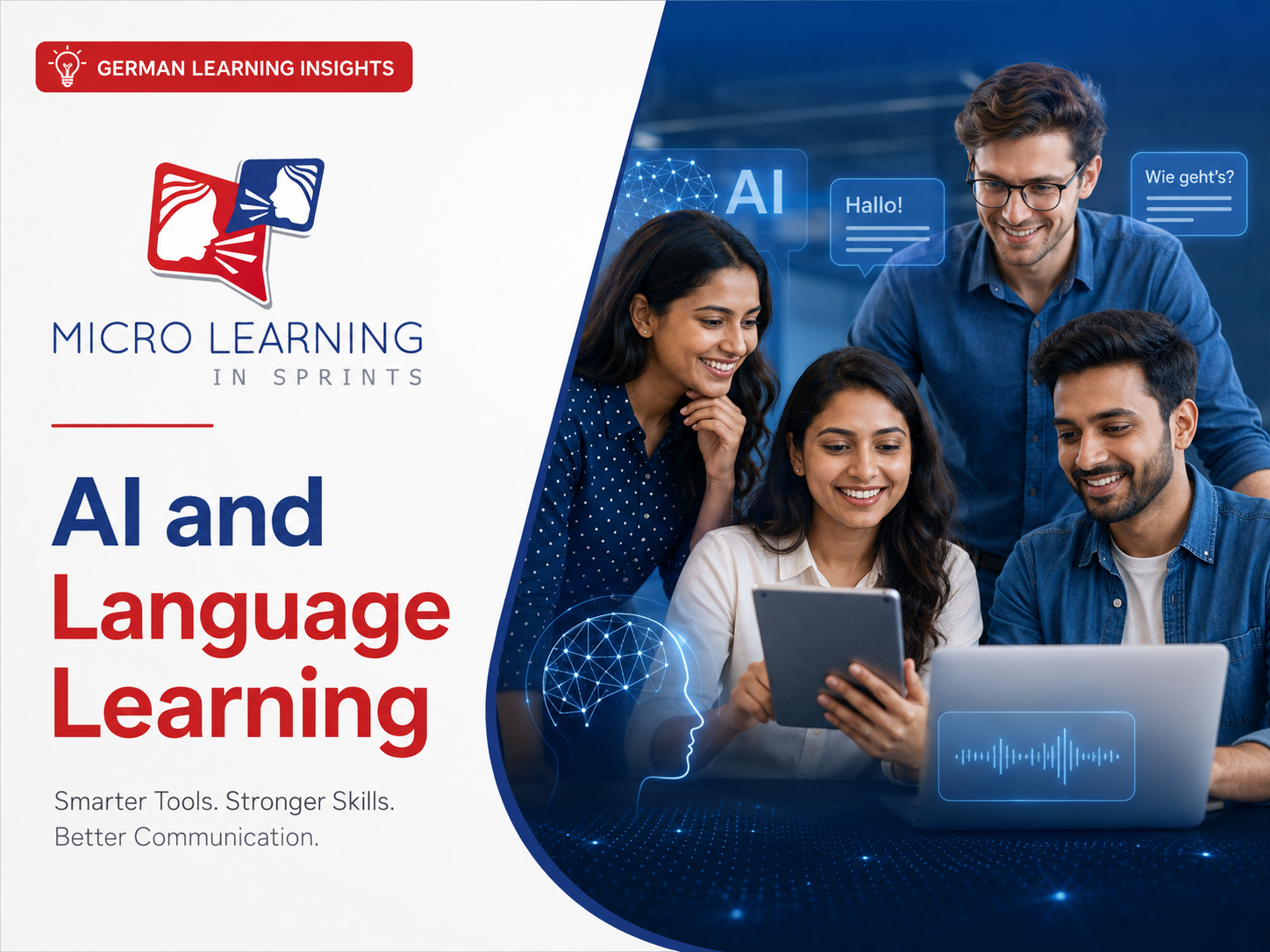
AI tools can translate German into English within seconds. So the question is fair: why should anyone still learn German?
The answer is simple: AI can translate words, but it cannot fully replace human connection.
When you learn a language, you are not only learning vocabulary. You are learning how people think, express respect, build trust, and communicate in real situations. This is especially important for students, professionals, and anyone planning to connect with German-speaking people for study, work, business, or travel.
Table of Contents
AI Helps, But It Does Not Replace Learning
Translation tools are incredibly useful. They can help you understand menus, emails, websites, and basic conversations. However, depending entirely on translation can sometimes make communication feel mechanical.
Imagine two professionals meeting a German client.
One person opens a translation app and waits.
The other says:
“Guten Morgen. Schön, Sie kennenzulernen.”
Good morning. Nice to meet you.
Who creates the stronger first impression?
Even a simple German greeting can demonstrate effort, respect, and confidence. That personal effort is something AI cannot do on your behalf.
Why German Still Matters for Professionals
Germany is globally known for engineering, manufacturing, research, renewable energy, sustainability, automation, and innovation. Many Indian students and professionals consider Germany for higher education, career growth, international exposure, and business opportunities.
In these situations, German language knowledge becomes more than just another skill. It can become a trust signal.
You may not need fluent German from day one. But learning German at the A1 level can help you:
- Introduce yourself confidently
- Understand simple conversations
- Communicate politely
- Develop cultural awareness
- Make a stronger first impression
- Prepare for advanced German learning
AI + German Is the Real Advantage
The future is not AI versus language learning.
The future is AI plus language learning.
AI can support your German journey through pronunciation tools, vocabulary practice, grammar correction, translations, and interactive exercises. But your own language skills give meaning and authenticity to communication.
AI may help you translate a sentence.
Learning German helps you understand the person behind the sentence.
How Beginners Should Start Learning German
You do not need to learn everything at once. Start small and build your confidence step by step.
Begin with:
- Greetings and introductions
- Numbers and basic vocabulary
- Simple questions
- Common German verbs
- Everyday words and phrases
- Short speaking exercises
- Beginner-level listening practice
A structured German A1 course can make this process easier by giving you a clear learning path instead of relying only on random apps and translation tools.
Final Thoughts
AI is powerful, but language is human.
Learning German demonstrates curiosity, effort, and respect for another culture. For students, working professionals, and global learners, these qualities can lead to better conversations, stronger connections, and new opportunities.
Ready to start learning German from the basics? Explore our 90-Day German A1 Sprint and begin your journey with a structured learning path.
FAQs
Can AI replace German learning?
AI can support translation and learning, but it cannot fully replace cultural understanding, personal confidence, and authentic human communication.
Is German A1 enough for beginners?
German A1 is the first level of German language learning and helps beginners develop essential vocabulary, grammar, and basic communication skills.
Can I use AI while learning German?
Absolutely. AI tools can be useful for vocabulary practice, pronunciation, grammar correction, translations, conversation practice, and personalized learning.
Ready to Start Your German A1 Journey?
Join Micro Learning In Sprints and build your German skills with a structured 90-day German A1 Sprint designed for beginners, students, working professionals, and global learners.